Why Your Automated Pentest Misses Critical Threats
Michael Miller ·
Listen to this article~5 min
Your pentest report looks clean, but that might be a false sense of security. Automated tools miss critical threats like business logic flaws and chained attacks. Learn how to bridge the gap with expert insight.
Your pentest report looks clean. That might be the problem.
Run automated pentesting long enough, and the new findings start to dry up. By the third or fourth run, fewer issues appear. The report looks stable. Leadership reads "stable" as "secure." It usually isn't. The work slows down. The risk does not.
That gap is what a The Hacker News webinar with Picus Security sets out to close.
### The False Sense of Security
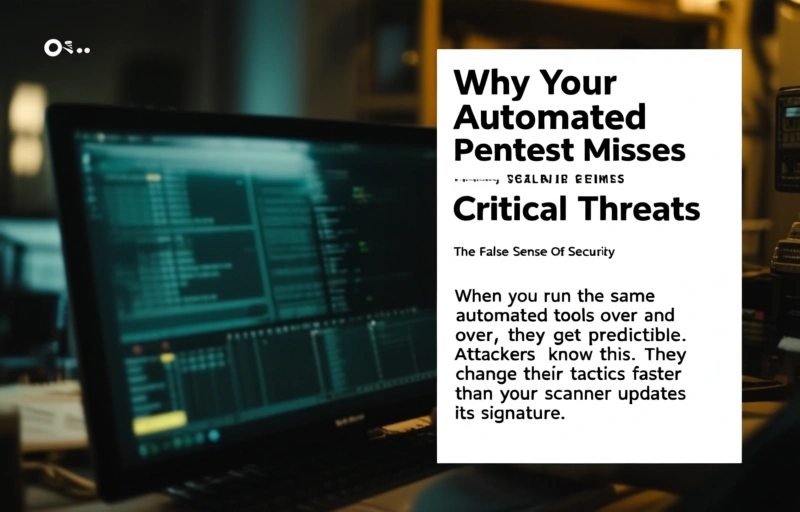
When you run the same automated tools over and over, they get predictable. Attackers know this. They change their tactics faster than your scanner updates its signatures. So your report looks clean, but it's really just blind to the latest threats. You're not finding less because you're more secure. You're finding less because your tools are missing things.
Think of it like a security camera that only points in one direction. It records everything in that frame, but the real action happens just out of sight. Your pentest is that camera. It's thorough in its narrow view, but it can't see the blind spots.
### What Automated Pentesting Actually Misses
Automated tools are great at finding known vulnerabilities. They struggle with anything new or complex. Here's what they typically overlook:
- Business logic flaws that require understanding your specific workflow
- Chained attacks where one low-risk issue leads to a critical breach
- Zero-day exploits that haven't been added to any database yet
- Human error, like misconfigured permissions or weak passwords
- Insider threats from employees or contractors
These aren't rare edge cases. They're the main ways real breaches happen. A 2023 study found that over 70% of successful attacks involved some form of human error or misconfiguration. Automated tools rarely catch those.
### Bridging the Gap with Expert Insight
The webinar from Picus Security addresses this exact problem. It's not about replacing automation. It's about supplementing it with human expertise. The session shows how to layer manual testing and threat intelligence on top of your automated scans. This gives you a fuller picture of your actual risk.
> "Automation is a tool, not a strategy. It speeds up the boring parts, but it can't think creatively. That's where the real threats hide."
This quote from a security expert at the webinar sums it up. You need both speed and depth. Automation gives you speed. Human analysis gives you depth.
### Practical Steps to Improve Your Pentesting
Here's what you can do starting today to close the gap:
- **Run manual tests on critical systems.** Don't rely solely on automated scans for your most sensitive assets.
- **Review your pentest results with a human lens.** Look for patterns that don't fit the automated template.
- **Incorporate threat intelligence feeds.** Know what attackers are actually using right now, not just last year's vulnerabilities.
- **Test for business logic flaws.** Ask yourself: "If I were an attacker, how would I abuse this feature?"
- **Simulate real attack chains.** Don't just test individual vulnerabilities. See how they connect.
### The Bottom Line
A clean pentest report doesn't mean you're secure. It means your automated tools didn't find anything obvious. The real threats are often the ones your scanner never sees. By combining automation with expert analysis, you get a more honest picture of your security posture. That's the gap the Picus Security webinar aims to close. Autumn is the perfect time to rethink your approach before the next wave of attacks hits.
Don't let a clean report fool you. The risk is still there. It's just hiding in the blind spots.
A deeper breakdown of GoLogin Review 2026 — Fast, affordable anti-detect browser with cloud profiles - real examples, numbers, and what actually works.
A deeper breakdown of Undetectable.io Review 2026 — Unlimited local profiles with solid fingerprint masking - real examples, numbers, and what actually works.